English language
2008/9 Schools Wikipedia Selection. Related subjects: Languages
| English | ||
|---|---|---|
| Pronunciation: | /ˈɪŋɡlɪʃ/ | |
| Spoken in: | Listed in the article | |
| Total speakers: | First language: 309–400 million Second language: 199–1,400 million Overall: 0.5–1.8 billion |
|
| Ranking: | 3 (native speakers) Total: 1 or 2 |
|
| Language family: | Indo-European Germanic West Germanic Anglo–Frisian Anglic English |
|
| Writing system: | Latin ( English variant) | |
| Official status | ||
| Official language in: | 53 countries United Nations United Nations European Union European Union Commonwealth of Nations Commonwealth of Nations |
|
| Regulated by: | no official regulation | |
| Language codes | ||
| ISO 639-1: | en | |
| ISO 639-2: | eng | |
| ISO 639-3: | eng | |
 |
||
| Note: This page may contain IPA phonetic symbols in Unicode. | ||
English is a West Germanic language originating in England, and is the first language for most people in the Anglophone Caribbean, Australia, Canada, New Zealand, the Republic of Ireland, the United Kingdom, and the United States (sometimes referred to as the Anglosphere). It is used extensively as a second language and as an official language throughout the world, especially in Commonwealth countries and in many international organisations. A native or fluent speaker of English is known as an Anglophone. (f. L. Anglo "English" + Gk. phone "sound, speech").
Modern English is sometimes described as the first global lingua franca. English is the dominant international language in communications, science, business, aviation, entertainment, radio and diplomacy. The influence of the British Empire is the primary reason for the initial spread of the language far beyond the British Isles. Since World War II, the growing economic and cultural influence of the United States has significantly accelerated the adoption of English.
A working knowledge of English is required in certain fields, professions, and occupations. As a result, over a billion people speak English at least at a basic level (see English language learning and teaching). English is one of six official languages of the United Nations.
History

English is an Anglo-Frisian language. Germanic-speaking peoples from northwest Germany ( Saxons and Angles) and Jutland ( Jutes) invaded what is now known as Eastern England around the fifth century AD. It is a matter of debate whether the Old English language spread by displacement of the original population, or the native Celts gradually adopted the language and culture of a new ruling class, or a combination of both of these processes (see Sub-Roman Britain).
Whatever their origin, these Germanic dialects eventually coalesced to a degree (there remained geographical variation) and formed what is today called Old English. Old English loosely resembles some coastal dialects in what are now northwest Germany and the Netherlands (i.e., Frisia). Throughout the history of written Old English, it retained a synthetic structure closer to that of Proto-Indo-European, largely adopting West Saxon scribal conventions, while spoken Old English became increasingly analytic in nature, losing the more complex noun case system, relying more heavily on prepositions and fixed word order to convey meaning. This is evident in the Middle English period, when literature was to an increasing extent recorded with spoken dialectal variation intact, after written Old English lost its status as the literary language of the nobility. It has been postulated that English retains some traits from a Celtic substratum. Later, it was influenced by the related North Germanic language Old Norse, spoken by the Vikings who settled mainly in the north and the east coast down to London, the area known as the Danelaw.
The Norman Conquest of England in 1066 greatly influenced the evolution of the language. For about 300 years after this, the Normans used Anglo-Norman, which was close to Old French, as the language of the court, law and administration. By the latter part of the fourteenth century, when English had replaced French as the language of law and government, Anglo-Norman borrowings had contributed roughly 10,000 words to English, of which 75% remain in use. These include many words pertaining to the legal and administrative fields, but also include common words for food, such as mutton, beef, and pork. However, the animals associated with these foods (e.g. sheep, cow, and swine ) retained their Saxon names, possibly because as a herd animal they were tended by Saxon serfs, while as food, they were more likely to be consumed at a Norman table. The Norman influence heavily influenced what is now referred to as Middle English. Later, during the English Renaissance, many words were borrowed directly from Latin (giving rise to a number of doublets) and Greek, leaving a parallel vocabulary that persists into modern times. By the seventeenth century there was a reaction in some circles against so-called inkhorn terms.
During the fifteenth century, Middle English was transformed by the Great Vowel Shift, the spread of a prestigious South Eastern-based dialect in the court, administration and academic life, and the standardising effect of printing. Early Modern English can be traced back to around the Elizabethan period.
Classification and related languages
The English language belongs to the western sub-branch of the Germanic branch of the Indo-European family of languages.
The question as to which is the nearest living relative of English is a matter of discussion. Apart from such English-lexified creole languages such as Tok Pisin, Scots (spoken primarily in Scotland and parts of Northern Ireland) is not a Gaelic language, but is part of the Anglic family of languages, having developed from early northern Middle English. It is Scots' indefinite status as a language or a group of dialects of English which complicates definitely calling it the closest language to English. The closest relatives to English after Scots are the Frisian languages, which are spoken in the Northern Netherlands and Northwest Germany. Other less closely related living West Germanic languages include German, Low Saxon, Dutch, and Afrikaans. The North Germanic languages of Scandinavia are less closely related to English than the West Germanic languages.
Many French words are also intelligible to an English speaker (though pronunciations are often quite different) because English absorbed a large vocabulary from Norman and French, via Anglo-Norman after the Norman Conquest and directly from French in subsequent centuries. As a result, a large portion of English vocabulary is derived from French, with some minor spelling differences (word endings, use of old French spellings, etc.), as well as occasional divergences in meaning, in so-called "faux amis", or false friends.
Geographical distribution
|
||||||||
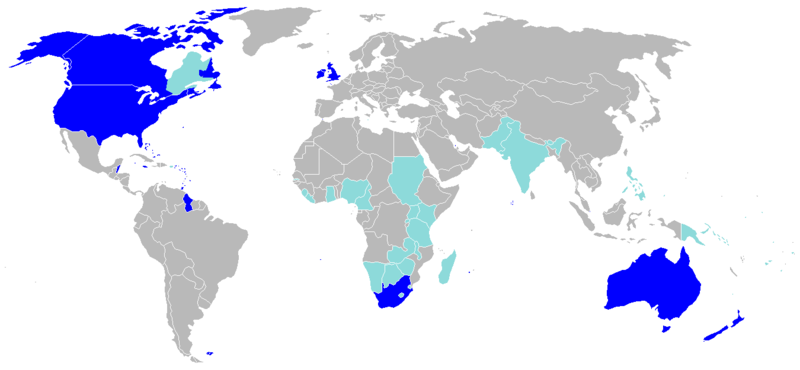
Approximately 375 million people speak English as their first language, as of 2006. English today is probably the third largest language by number of native speakers, after Mandarin Chinese and Spanish. However, when combining native and non-native speakers it is probably the most commonly spoken language in the world, though possibly second to a combination of the Chinese Languages, depending on whether or not distinctions in the latter are classified as "languages" or "dialects." Estimates that include second language speakers vary greatly from 470 million to over a billion depending on how literacy or mastery is defined. There are some who claim that non-native speakers now outnumber native speakers by a ratio of 3 to 1.
The countries with the highest populations of native English speakers are, in descending order: United States (215 million), United Kingdom (58 million), Canada (17.7 million), Australia (15.5 million), Ireland (3.8 million), South Africa (3.7 million), and New Zealand (3.0-3.7 million). Countries such as Jamaica and Nigeria also have millions of native speakers of dialect continua ranging from an English-based creole to a more standard version of English. Of those nations where English is spoken as a second language, India has the most such speakers (' Indian English') and linguistics professor David Crystal claims that, combining native and non-native speakers, India now has more people who speak or understand English than any other country in the world. Following India is the People's Republic of China.

| Country | Native speakers | |
|---|---|---|
| 1 |  United States United States |
214,809,000 |
| 2 |  United Kingdom United Kingdom |
58,200,000 |
| 3 |  Canada Canada |
17,694,830 |
| 4 |  Australia Australia |
15,581,334 |
| 5 |  Ireland Ireland |
4,200,000+ (Approx) |
| 6 |  South Africa South Africa |
3,673,203 |
| 7 |  New Zealand New Zealand |
3,500,000+ (Approx) |
| 8 |  Singapore Singapore |
665,087 |
English is the primary language in Anguilla, Antigua and Barbuda, Australia ( Australian English), the Bahamas, Barbados, Bermuda, Belize, the British Indian Ocean Territory, the British Virgin Islands, Canada ( Canadian English), the Cayman Islands, the Falkland Islands, Gibraltar, Grenada, Guam, Guernsey ( Guernsey English), Guyana, Ireland ( Hiberno-English), Isle of Man ( Manx English), Jamaica ( Jamaican English), Jersey, Montserrat, Nauru, New Zealand ( New Zealand English), Pitcairn Islands, Saint Helena, Saint Kitts and Nevis, Saint Vincent and the Grenadines, South Georgia and the South Sandwich Islands, Trinidad and Tobago, the Turks and Caicos Islands, the United Kingdom, the U.S. Virgin Islands, and the United States (various forms of American English).
In many other countries, where English is not the most spoken language, it is an official language; these countries include Botswana, Cameroon, Dominica, Fiji, the Federated States of Micronesia, Ghana, Gambia, India, Kiribati, Lesotho, Liberia, Kenya, Madagascar, Malta, the Marshall Islands, Mauritius, Namibia, Nigeria, Pakistan, Palau, Papua New Guinea, the Philippines, Puerto Rico, Rwanda, the Solomon Islands, Saint Lucia, Samoa, Seychelles, Sierra Leone, Singapore, Sri Lanka, Swaziland, Tanzania, Uganda, Zambia, and Zimbabwe. It is also one of the 11 official languages that are given equal status in South Africa ( South African English). English is also the official language in current dependent territories of Australia (Norfolk Island, Christmas Island and Cocos Island) and of the United States (Northern Mariana Islands, American Samoa and Puerto Rico), and in the former British colony of Hong Kong.
English is an important language in several former colonies and protectorates of the United Kingdom but falls short of official status, such as in Malaysia, Brunei, United Arab Emirates and Bahrain. English is also not an official language in either the United States or the United Kingdom. Although the United States federal government has no official languages, English has been given official status by 30 of the 50 state governments.
English as a global language
Because English is so widely spoken, it has often been referred to as a " global language", the lingua franca of the modern era. While English is not an official language in most countries, it is currently the language most often taught as a second language around the world. Some linguists believe that it is no longer the exclusive cultural sign of "native English speakers", but is rather a language that is absorbing aspects of cultures worldwide as it continues to grow. It is, by international treaty, the official language for aerial and maritime communications, as well as one of the official languages of the European Union, the United Nations, and most international athletic organisations, including the International Olympic Committee.
English is the language most often studied as a foreign language in the European Union (by 89% of schoolchildren), followed by French (32%), German (18%), and Spanish (8%). In the EU, a large fraction of the population reports being able to converse to some extent in English. Among non-English speaking countries, a large percentage of the population claimed to be able to converse in English in the Netherlands (87%), Sweden (85%), Denmark (83%), Luxembourg (66%), Finland (60%), Slovenia (56%), Austria (53%), Belgium (52%), and Germany (51%). Norway and Iceland also have a large majority of competent English-speakers.
Books, magazines, and newspapers written in English are available in many countries around the world. English is also the most commonly used language in the sciences. In 1997, the Science Citation Index reported that 95% of its articles were written in English, even though only half of them came from authors in English-speaking countries.
Dialects and regional varieties
The expansion of the British Empire and—since WWII—the primacy of the United States have spread English throughout the globe. Because of that global spread, English has developed a host of English dialects and English-based creole languages and pidgins.
The major varieties of English include, in most cases, several subvarieties, such as Cockney slang within British English; Newfoundland English within Canadian English; and African American Vernacular English (" Ebonics") and Southern American English within American English. English is a pluricentric language, without a central language authority like France's Académie française; and, although no variety is clearly considered the only standard, there are a number of accents considered to be more prestigious, such as Received Pronunciation in Britain.
Scots developed — largely independently — from the same origins, but following the Acts of Union 1707 a process of language attrition began, whereby successive generations adopted more and more features from English causing dialectalisation. Whether it is now a separate language or a dialect of English better described as Scottish English is in dispute. The pronunciation, grammar and lexis of the traditional forms differ, sometimes substantially, from other varieties of English.
Because of the wide use of English as a second language, English speakers have many different accents, which often signal the speaker's native dialect or language. For the more distinctive characteristics of regional accents, see Regional accents of English speakers, and for the more distinctive characteristics of regional dialects, see List of dialects of the English language.
Just as English itself has borrowed words from many different languages over its history, English loanwords now appear in a great many languages around the world, indicative of the technological and cultural influence of its speakers. Several pidgins and creole languages have formed using an English base, such as Jamaican Creole, Nigerian Pidgin, and Tok Pisin. There are many words in English coined to describe forms of particular non-English languages that contain a very high proportion of English words. Franglais, for example, is used to describe French with a very high English word content; it is found on the Channel Islands. Another variant, spoken in the border bilingual regions of Québec in Canada, is called Frenglish.
Constructed varieties of English
- Basic English is simplified for easy international use. It is used by manufacturers and other international businesses to write manuals and communicate. Some English schools in Asia teach it as a practical subset of English for use by beginners.
- Special English is a simplified version of English used by the Voice of America. It uses a vocabulary of only 1500 words.
- English reform is an attempt to improve collectively upon the English language.
- Seaspeak and the related Airspeak and Policespeak, all based on restricted vocabularies, were designed by Edward Johnson in the 1980s to aid international cooperation and communication in specific areas. There is also a tunnelspeak for use in the Channel Tunnel.
- Euro-English is a concept of standardising English for use as a second language in continental Europe.
- Manually Coded English — a variety of systems have been developed to represent the English language with hand signals, designed primarily for use in deaf education. These should not be confused with true sign languages such as British Sign Language and American Sign Language used in Anglophone countries, which are independent and not based on English.
- E-Prime excludes forms of the verb to be.
Euro-English (also EuroEnglish or Euro-English) terms are English translations of European concepts that are not native to English-speaking countries. Because of the United Kingdom's (and even the Republic of Ireland's) involvement in the European Union, the usage focuses on non-British concepts. This kind of Euro-English was parodied when English was "made" one of the constituent languages of Europanto.
Phonology
Vowels
| IPA | Description | word |
|---|---|---|
| monophthongs | ||
| i/iː | Close front unrounded vowel | bead |
| ɪ | Near-close near-front unrounded vowel | bid |
| ɛ | Open-mid front unrounded vowel | bed |
| æ | Near-open front unrounded vowel | bad |
| ɒ | Open back rounded vowel | box 1 |
| ɔ/ɑ | Open-mid back rounded vowel | pawed 2 |
| ɑ/ɑː | Open back unrounded vowel | bra |
| ʊ | Near-close near-back rounded vowel | good |
| u/uː | Close back rounded vowel | booed |
| ʌ/ɐ/ɘ | Open-mid back unrounded vowel, Near-open central vowel | bud |
| ɝ/ɜː | Open-mid central unrounded vowel | bird 3 |
| ə | Schwa | Rosa's 4 |
| ɨ | Close central unrounded vowel | roses 5 |
| diphthongs | ||
| e(ɪ)/eɪ | Close-mid front unrounded vowel Close front unrounded vowel |
bayed 6 |
| o(ʊ)/əʊ | Close-mid back rounded vowel Near-close near-back rounded vowel |
bode 6 |
| aɪ | Open front unrounded vowel Near-close near-front unrounded vowel |
cry |
| aʊ | Open front unrounded vowel Near-close near-back rounded vowel |
bough |
| ɔɪ | Open-mid back rounded vowel Close front unrounded vowel |
boy |
| ʊɚ/ʊə | Near-close near-back rounded vowel Schwa |
boor 9 |
| ɛɚ/ɛə/eɚ | Open-mid front unrounded vowel Schwa |
fair 10 |
Notes:
It is the vowels that differ most from region to region.
Where symbols appear in pairs, the first corresponds to American English, General American accent; the second corresponds to British English, Received Pronunciation.
- American English lacks this sound; words with this sound are pronounced with /ɑ/ or /ɔ/.
- Many dialects of North American English do not have this vowel. See Cot-caught merger.
- The North American variation of this sound is a rhotic vowel.
- Many speakers of North American English do not distinguish between these two unstressed vowels. For them, roses and Rosa's are pronounced the same, and the symbol usually used is schwa /ə/.
- This sound is often transcribed with /i/ or with /ɪ/.
- The diphthongs /eɪ/ and /oʊ/ are monophthongal for many General American speakers, as /eː/ and /oː/.
- The letter <U> can represent either /u/ or the iotated vowel /ju/. In BRP, if this iotated vowel /ju/ occurs after /t/, /d/, /s/ or /z/, it often triggers palatalization of the preceding consonant, turning it to /ʨ/, /ʥ/, /ɕ/ and /ʑ/ respectively, as in tune, during, sugar, and azure. In American English, palatalization does not generally happen unless the /ju/ is followed by r, with the result that /(t, d,s, z)jur/ turn to /tʃɚ/, /dʒɚ/, /ʃɚ/ and /ʒɚ/ respectively, as in nature, verdure, sure, and treasure.
- Vowel length plays a phonetic role in the majority of English dialects, and is said to be phonemic in a few dialects, such as Australian English and New Zealand English. In certain dialects of the modern English language, for instance General American, there is allophonic vowel length: vowel phonemes are realized as long vowel allophones before voiced consonant phonemes in the coda of a syllable. Before the Great Vowel Shift, vowel length was phonemically contrastive.
- This sound only occurs in non-rhotic accents. In some accents, this sound may be, instead of /ʊə/, /ɔ:/. See pour-poor merger.
- This sound only occurs in non-rhotic accents. In some accents, the schwa offglide of /ɛə/ may be dropped, monophthising and lengthening the sound to /ɛ:/.
Consonants
This is the English Consonantal System using symbols from the International Phonetic Alphabet (IPA).
| bilabial | labio- dental |
dental | alveolar | post- alveolar |
palatal | velar | glottal | |
|---|---|---|---|---|---|---|---|---|
| plosive | p b | t d | k ɡ | |||||
| nasal | m | n | ŋ 1 | |||||
| flap | ɾ 2 | |||||||
| fricative | f v | θ ð 3 | s z | ʃ ʒ 4 | ç 5 | x 6 | h | |
| affricate | tʃ dʒ 4 | |||||||
| approximant | ɹ 4 | j | ||||||
| lateral approximant | l |
| labial-velar | |
|---|---|
| approximant | ʍ w 7 |
- The velar nasal [ŋ] is a non-phonemic allophone of /n/ in some northerly British accents, appearing only before /k/ and /g/. In all other dialects it is a separate phoneme, although it only occurs in syllable codas.
- The alveolar flap [ɾ] is an allophone of /t/ and /d/ in unstressed syllables in North American English and Australian English. This is the sound of tt or dd in the words latter and ladder, which are homophones for many speakers of North American English. In some accents such as Scottish English and Indian English it replaces /ɹ/. This is the same sound represented by single r in most varieties of Spanish.
- In some dialects, such as Cockney, the interdentals /θ/ and /ð/ are usually merged with /f/ and /v/, and in others, like African American Vernacular English, /ð/ is merged with dental /d/. In some Irish varieties, /θ/ and /ð/ become the corresponding dental plosives, which then contrast with the usual alveolar plosives.
- The sounds /ʃ/, /ʒ/, and /ɹ/ are labialised in some dialects. Labialisation is never contrastive in initial position and therefore is sometimes not transcribed. Most speakers of General American realize <r> (always rhoticized) as the retroflex approximant /ɻ/, whereas the same is realized in Scottish English, etc. as the alveolar trill.
- The voiceless palatal fricative /ç/ is in most accents just an allophone of /h/ before /j/; for instance human /çjuːmən/. However, in some accents (see this), the /j/ is dropped, but the initial consonant is the same.
- The voiceless velar fricative /x/ is used by Scottish or Welsh speakers of English for Scots/Gaelic words such as loch /lɒx/ or by some speakers for loanwords from German and Hebrew like Bach /bax/ or Chanukah /xanuka/. /x/ is also used in South African English. In some dialects such as Scouse (Liverpool) either [x] or the affricate [kx] may be used as an allophone of /k/ in words such as docker [dɒkxə]. Most native speakers have a great deal of trouble pronouncing it correctly when learning a foreign language. Most speakers use the